2026 Volvo Standard & Optional Safety Features
Shopping for a new Volvo often starts with a simple question: what safety technology comes with the car, and what do you have to add? Understanding Standard & Optional Volvo Safety Features makes a real difference when comparing trims, because Volvo builds an unusually generous baseline into every model before you even look at package upgrades. If you'd like to see these systems in person, browse our new Volvo inventory at Volvo Cars Mission Viejo and get a feel for how each trim is equipped.
Volvo's approach to safety isn't a marketing slogan. Volvo's Traffic Accident Research Team has studied more than 50,000 accidents involving over 80,000 occupants since 1970, and that research still shapes how the company engineers both standard and optional systems today. This breakdown covers what actually comes on the car, and what you'll need to add.
Understanding Standard vs. Optional Volvo Safety Features
Volvo's IntelliSafe suite is the backbone of safety across the lineup. A core group of protective technologies, including AEB (automatic emergency braking), lane support, and driver monitoring, comes standard on every new Volvo regardless of trim.
Upgraded packages then layer on more advanced ADAS (advanced driver-assistance systems) features like Pilot Assist, the 360-Degree Camera, and Park Assist Pilot. Knowing which bucket a feature falls into helps you decide whether a base trim already covers your needs or whether stepping up a trim level is worth it.
Collision Avoidance: Standard Protection and Optional Upgrades
Collision avoidance is where Volvo's standard equipment list is most impressive.
Automated Emergency Braking and City Safety
AEB comes standard on every Volvo car and works hand in hand with City Safety, which is also standard on every new Volvo. Volvo engineers City Safety to use radar, camera, and ultrasonic sensors that detect vehicles, cyclists, pedestrians, and large animals, applying braking automatically if a collision looks imminent. The system also includes intersection assistance, which matters for anyone navigating busy South Orange County intersections during a daily commute.
Optional Enhanced Collision Avoidance Technologies
Automatic emergency steering, which can nudge the car away from a hazard rather than just braking, is a collision avoidance capability Volvo offers on the EX90. Configurations vary, so confirm availability on the specific vehicle you're considering. It's a meaningful upgrade for drivers who want extra margin at higher speeds, such as on the 5 Freeway during heavy traffic.
Driver Awareness Features That Keep You Alert
Staying alert behind the wheel matters just as much as the car's own sensors, and Volvo builds in tools to support both.
Standard Lane Support and Driver Alert Systems
The lane-support suite, including Lane Keeping Aid, oncoming lane mitigation, and run-off road mitigation, comes standard across the lineup. Run-off road mitigation also tightens the seatbelts if the car senses it's leaving the roadway. Driver Alert Control is built in as well, monitoring driving patterns for signs of fatigue. Driver Understanding uses sensors and a capacitive steering wheel to track gaze and hand positioning, a helpful check during long family road trips when fatigue creeps up gradually.
Optional Pilot Assist and Now-Standard Adaptive Cruise Control
Pilot Assist, part of the optional IntelliSafe Assist package, maintains speed and a safe following distance, can stop and resume in traffic, and gently steers to stay centered in the lane. It works on marked roads up to 180 km/h. At lower speeds Pilot Assist can operate without a lead vehicle, while at higher speeds it needs one ahead to follow. A capacitive sensor confirms your hands are on the wheel throughout.
Pilot Assist helps with steering and speed, but it isn't self-driving. Driver attention is required at all times regardless of whether the system is engaged, and the driver remains responsible in every situation, whether cruising the 5 Freeway or navigating a school drop-off line.
Adaptive cruise control is now standard across all 2026 Volvo models, a notable upgrade for the XC40 in particular, since it previously required an add-on. Volvo's safety ratings have stayed consistently strong for years, and this kind of standardization fits that pattern.
Parking Assistance: Sensors and Camera Systems
Tight Orange County parking structures make a strong case for parking assistance technology, and Volvo splits this category clearly between standard and optional equipment.
Standard Parking Sensors and Rear Camera
Rear Park Assist sensors and the Park Assist Camera come standard, giving drivers audible and visual cues when backing into a spot or pulling out of a driveway.
Optional 360-Degree Camera and Park Assist Pilot
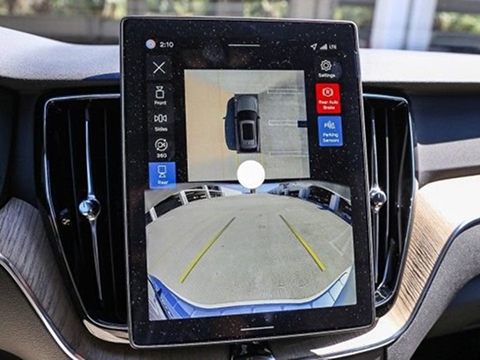
Front Park Assist sensors, a Front Park Assist Camera, and the full 360-Degree Camera are available as options, offering a bird's-eye view that's genuinely useful in cramped garages. Park Assist Pilot goes further, steering the car into a spot while the driver still controls the pedals, operating up to 19 mph (30 km/h) for parallel parking and up to 12 mph (20 km/h) for perpendicular parking. Sensors do have limitations, though. Some materials, small children or animals, and thin poles may not always be detected, so drivers should still stay visually aware while parking.
If you're weighing a new purchase against a pre-owned option with some of these packages already installed, it's worth a look, and our financing team can walk you through options for either path.
Blind-Spot Monitoring and Cross-Traffic Alerts
BLIS (Blind Spot Information System) uses mirror-mounted cameras to watch for vehicles in adjacent lanes, and it's common across the lineup, though its standard/optional status depends on the model and trim. On vehicles built on Volvo's SPA platform, an advanced version of BLIS adds Steer Assist, Cross Traffic Alert, and Rear Collision Warning.
Cross Traffic Alert uses rear-mounted radar to watch for vehicles crossing behind you when reversing, and its auto-brake function can stop the car if a collision looks likely. It's most effective when the sensors have a clear view to each side, so treat it as a second set of eyes rather than a substitute for backing out slowly.
On some nameplates, this technology is standard on higher trims but optional on the base trim, so it's worth checking model by model. On the XC90, every trim level from Core up through Ultra includes Pilot Assist, City Safety, BLIS, and Cross Traffic Alert as standard equipment, making it one of the most generously equipped models in the lineup.
Occupant Protection and Volvo's Body Engineering
Beyond the electronics, Volvo's occupant protection relies on decades of structural engineering. Every vehicle includes a cage of ultra-high-strength steel around the A- and B-pillars and roof rails, paired with crumple zones that Volvo introduced back in 1966 and has refined ever since using four distinct steel grades.
Front, side, and curtain airbags with occupant sensing come standard in every vehicle Volvo sells. SIPS (Side Impact Protection System) has been part of the lineup since 1991, and WHIPS (Whiplash Protection System) followed in 1998, both remaining foundational to how Volvo designs cabin safety today.
Newer technology is arriving with the EVs, too. The multi-adaptive safety belt debuts on Volvo's newest electric models, with the EX60 set to be the first car to carry it, and electric and plug-in hybrid models also get a dedicated battery safety cage built into the structure. Volvo crash ratings tend to hold up well over time largely because of this kind of continuous refinement.
Connected Safety and Emergency Support Services
Volvo's Connected Safety features let cars share information about road hazards in real time. Slippery Road Alert and Hazard Light Alert come standard on all Volvo cars across Europe, the United States, and Canada, with the exception of the EX30. These alerts can warn you about icy patches or stopped traffic before you can see the hazard yourself, especially useful on unfamiliar routes during a family road trip.
Emergency support is built in as well. An automatic emergency call triggers after a severe collision or can be activated manually with the SOS button, while a separate Assist button connects drivers to non-emergency roadside help through Volvo Assistance. Many of these connected features run through Volvo's Sensus infotainment system, and if you want a closer look at how that screen and its connected tools work in the newest models, our Volvo infotainment features breakdown covers it in more depth.
How Feature Availability Varies by Model, Trim, and Year
Feature availability shifts depending on the model, trim, and model year, so it helps to think about your own driving habits before deciding which package to prioritize. Highway commuters who spend a lot of time on the 5 Freeway will likely get the most value from Pilot Assist and adaptive cruise control.
Drivers who spend more time navigating tight city streets or parking structures should lean toward the 360-Degree Camera and Park Assist Pilot. Families who prioritize a wide safety margin around the vehicle should look closely at BLIS and Cross Traffic Alert availability, alongside the occupant protection features already built into every model.
On the XC60 and XC90, the 360-Degree Camera and Pilot Assist become available starting at the Plus trim. On the XC40, Pilot Assist is held back until the top Ultra trim, so shoppers focused on that model should plan accordingly. The sedans, S60 and S90, include City Safety, blind-spot monitoring, and adaptive cruise control as standard, giving them a strong baseline without needing to move up trims.
| Feature | Standard/Optional | XC40 | XC60 | XC90 | Notes |
|---|---|---|---|---|---|
| City Safety / AEB | Standard | Yes | Yes | Yes | Standard on every new Volvo |
| BLIS & Cross Traffic Alert | Standard on all trims | Standard | Standard | Standard all trims | Standard across the 2026 lineup |
| Pilot Assist | Optional | Ultra trim only | From Plus trim | From Plus trim | Adaptive cruise now standard on 2026 models |
| 360-Degree Camera | Optional | Available | From Plus trim | From Plus trim | Front sensors/camera also optional |
It's also worth remembering that drivers can deactivate Lane Keeping Aid, BLIS, and Connected Safety features, and these typically need to be manually reactivated each drive cycle. Our factory-trained technicians can walk you through which packages actually fit your routine, whether that's a daily freeway commute or weekend trips around Mission Viejo, without pushing you toward more than you need.
Compare Safety Technology at Volvo Cars Mission Viejo
2026 Crash Ratings
The 2026 XC90, in both gas and PHEV form, earned an IIHS Top Safety Pick for 2026, with Good ratings across key crash tests and Good headlights. Only two 2026 Volvo models earned an IIHS Top Safety Pick distinction: the EX90, which achieved the top-tier Top Safety Pick+, and the XC90 (including its plug-in hybrid variant), which earned Top Safety Pick. The XC40 also performed well, earning Good ratings for small overlap front and moderate overlap front tests, along with Good seat belt reminders, according to IIHS. These results reflect a pattern that's been consistent for years.
Schedule a Visit
If you're trying to match a specific safety package to your daily driving, our team at Volvo Cars Mission Viejo can compare trims side by side and explain exactly what's standard versus optional on the model you're considering. Every vehicle that comes through our state-of-the-art service center is also inspected on systems like Pilot Assist and BLIS, so you can trust the technology is working as intended long after purchase.
Contact us online or stop by to schedule a test drive, and see for yourself how Standard & Optional Volvo Safety Features come together on the road.